





For couples with a family history of genetic disorders, the desire to have a healthy baby comes with concern. This is especially true for diseases that affect the quality of life, such as haemophilia, or hemophilia, a blood disorder that can lead to excessive bleeding. However, with advancements in reproductive technology, there are now ways to alleviate these concerns.
This article aims to provide an in-depth understanding of hemophilia, including its causes, symptoms, and solutions for preventing the transmission of this genetic disorder to the next generation.
What is Hemophilia and Why Is It Called the “Bleeding Disorder”?
Hemophilia is a blood clotting disorder caused by a deficiency in certain proteins essential for the clotting process (Clotting Factor). There are two main types of hemophilia:
- Hemophilia A: Caused by a lack of Factor VIII (Factor 8)
- Hemophilia B: Caused by a lack of Factor IX (Factor 9)
When these proteins are deficient, blood cannot clot properly, causing excessive bleeding even from minor injuries. This is why hemophilia is commonly referred to as the “bleeding disorder.”
How Common is Hemophilia?
Although Hemophilia is classified as a rare disease, it occurs more frequently than many realize, particularly in male infants. Because it is inherited via the X chromosome, males who have only one X chromosome are significantly more likely to be affected than females.
Global data suggests that approximately 1 in 5,000 male infants is born with Hemophilia. Women who carry the abnormal gene but do not show symptoms are considered “carriers,” occurring in about 1 in 5,000 to 10,000 women. While they may not appear ill, they can still pass the gene to their children. In Asia, including Thailand, the prevalence is consistent with global averages.
References: International Society on Thrombosis and Haemostasis (ISTH), World Federation of Hemophilia (WFH Global Report 2023).
Symptoms to Watch for in Hemophilia
The severity of symptoms varies based on the level of clotting factor the body can produce. Generally, a haemophilia symptom to watch for includes:
- Easy bruising or large bruises appearing frequently
- Prolonged bleeding from minor cuts or injuries
- Joint bleeding (Joint Bleeding) which is one of the most dangerous symptoms, leads to pain and swelling, and potentially causing permanent joint damage or disability if recurring
What Causes Haemophilia? Understanding Genetic Inheritance
Hemophilia is an inherited genetic disorder caused by a mutation on the X chromosome, which determines gender. The disease follows an X-linked recessive pattern of inheritance, meaning that the expression of the disease depends on the recipient’s sex. Because males have only one X chromosome (XY), they are more likely to inherit the disorder than females.
Here’s how hemophilia is transmitted:
- Men (XY): Males have only one X chromosome. If the X chromosome they inherit from their mother carries the defective gene, they will develop hemophilia immediately because there is no second X chromosome to compensate.
- Women (XX): Females have two X chromosomes. If one X chromosome carries the defective gene but the other is normal, they will be carriers of the disease (without showing symptoms). They can, however, pass the defective gene to their children.
Example of genetic transmission:
- If the mother is a carrier and the father is normal, their son has a 50% chance of having hemophilia, while their daughter has a 50% chance of being a carrier.
- If the father has hemophilia and the mother is not a carrier, all daughters will be carriers, and none of the sons will have hemophilia.
Without genetic screening before pregnancy, many couples remain unaware of the risk of passing this gene to their children. Knowing your carrier status is vital for effective family planning.
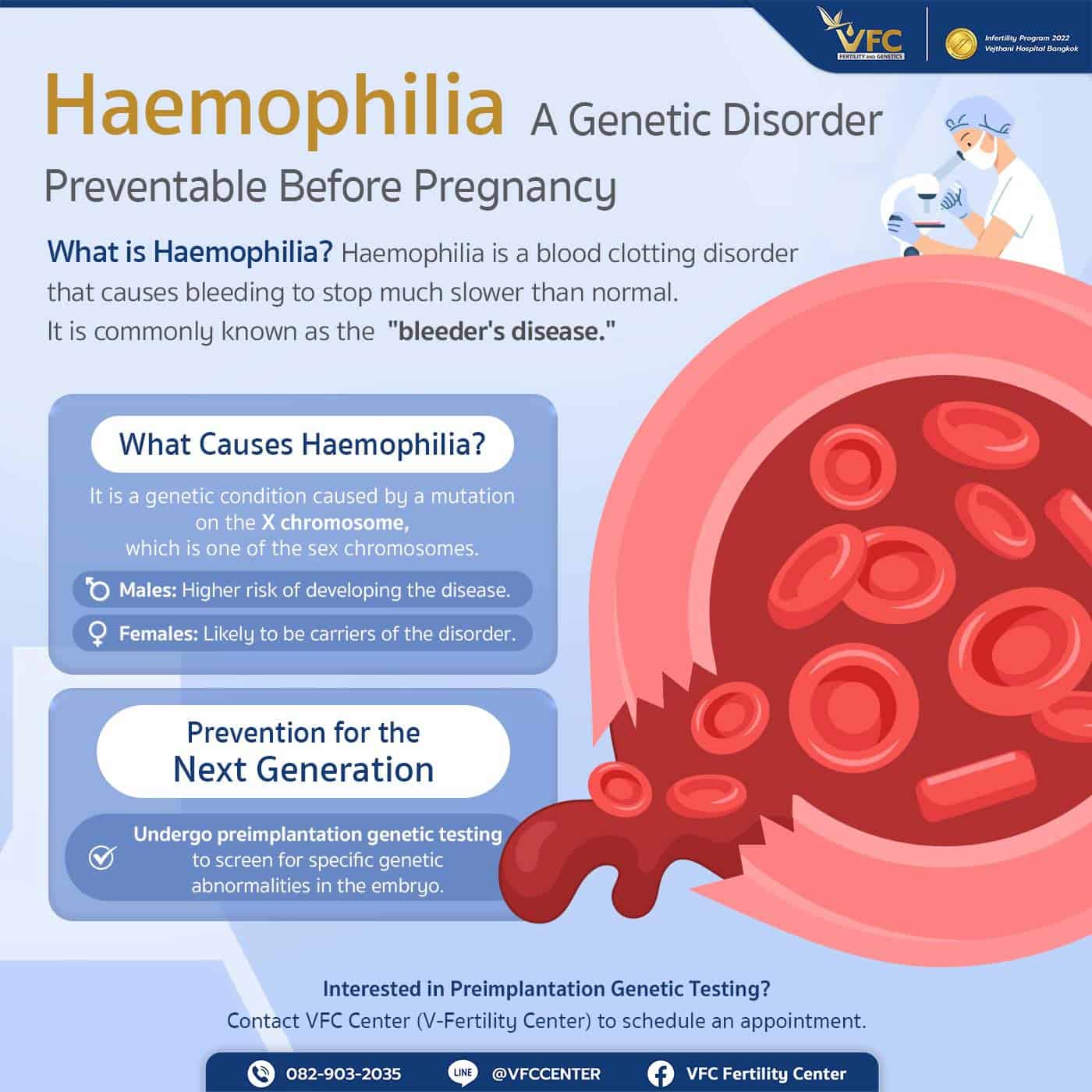
Screening for genetic disorders before family planning at VFC Center – V-Fertility Center.

Solutions to Prevent Hemophilia Transmission
For couples who know they are carriers or are at risk, relying on natural conception can cause great anxiety. Today, science offers a precise and safe alternative through embryo genetic testing. This allows for planning at the cellular level, enabling couples to break the cycle of inheritance and increase confidence in a healthy pregnancy.
ICSI: The Essential First Step
Before embryos can be genetically tested, couples must undergo Intracytoplasmic Sperm Injection (ICSI) to create the embryos. The process includes:
- Ovarian stimulation.
- Egg retrieval.
- Laboratory fertilization and embryo culture.
Preimplantation Genetic Testing of Embryos
Once embryos are created, the most critical step is to perform preimplantation genetic testing (PGT-M) to screen for the specific genetic defects associated with hemophilia. Scientists will take a few cells from the embryos for analysis to select the healthiest embryos.
Hemophilia is not the end of the road for family planning but is merely the beginning of medical planning. Preimplantation genetic testing (PGT-M) offers an effective solution and hope for couples concerned about passing on genetic disorders. At VFC Center (V-Fertility Center), we provide personalized care, analyzing everything from hormones and immunity to the uterine environment to maximize your chances of a successful, healthy pregnancy.
Article by DR. SORRAMON SONGVEERATHAM
Contact or Book a Consultation:
VFC Center – V-Fertility Center
Hotline: 082-903-2035
LINE Official: @vfccenter
Frequently Asked Questions (FAQs)
Q : How is Hemophilia inherited?
A : This condition is inherited through the X chromosome. Women are carriers, while men who inherit the defective X chromosome from their mothers will develop hemophilia. Pre-pregnancy screening helps reduce the risk of passing on the disease to future generations.
Q : Can Hemophilia transmission be prevented?
A : Yes, with reproductive technologies like preimplantation genetic testing (PGT-M) combined with ICSI, couples can select embryos free of genetic defects before implantation, ensuring a healthy pregnancy.
Q : What should I do if I have a family history of Hemophilia?
A : We recommend starting with Carrier Screening for both partners, especially the wife, as the disease is X-linked. Identifying whether the mother is a carrier allows for accurate risk assessment and is essential data for the PGT-M process. This ensures you can have a healthy child without the risks or gender-guessing of the past.

OBSTETRICS AND GYNAECOLOGY-REPRODUCTIVE MEDICINE
No Comments
Sorry, the comment form is closed at this time.