





Key Takeaways
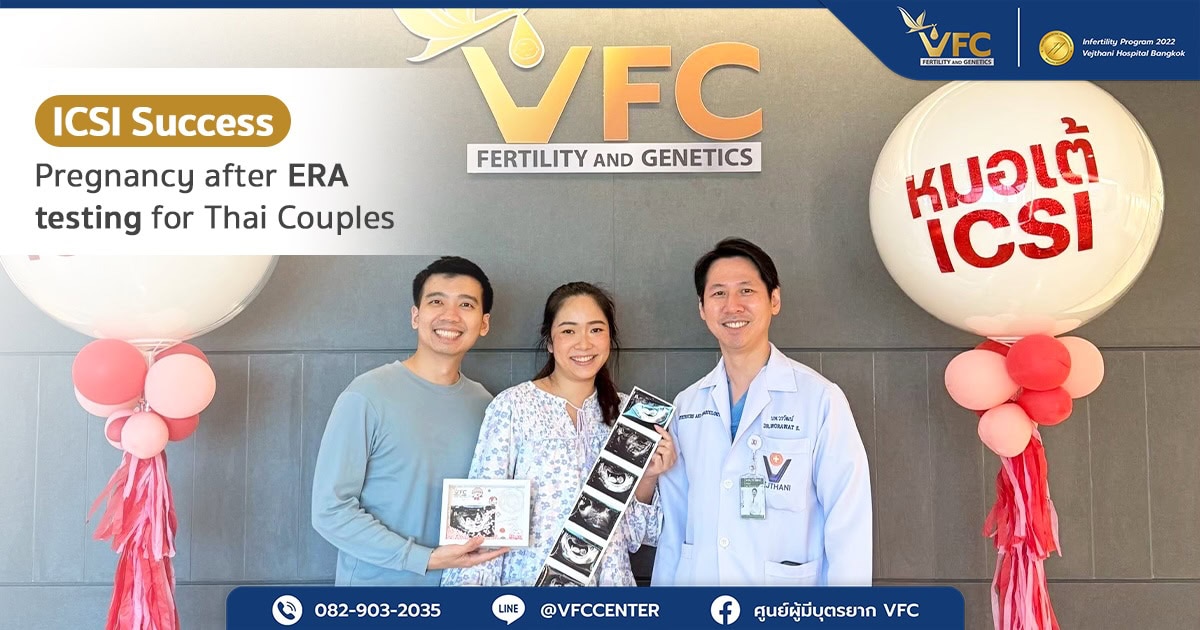
Khun Baitoei and Khun Ohm navigated a challenging infertility experience, facing multiple hurdles on their path to parenthood. Their journey included IUI, ICSI, and multiple embryo transfers. By incorporating pregnancy after Endometrial Receptivity Analysis (ERA testing), the medical team ensured her uterine environment was perfectly synchronized for implantation. Khun Baitoei’s story is a powerful example of how persistence and advanced technology can overcome significant obstacles to achieve a successful pregnancy.
The path to parenthood is rarely a straight line, especially for couples navigating a challenging infertility experience. It requires immense patience, resilience, and a multi-step medical approach to reach the desired goal. The case of Khun Baitoei and Khun Ohm is a powerful testament to the “never give up” spirit.
Despite enduring multiple embryo transfers five attempts in total they faced every hurdle with determination. Their journey finally culminated in a successful pregnancy after Endometrial Receptivity Analysis (ERA testing). This story serves as an inspiration to anyone facing similar hurdles, proving that persistence, combined with the right technology, leads to life-changing results
Attending Physician: Dr. WORAWAT SIRIPOON
Consult with a reproductive specialist to design your personalized pregnancy plan.
The First Steps and Critical Preliminary Testing
Khun Baitoei initially began her journey with IUI (Intrauterine Insemination). When the first attempt was unsuccessful, Dr. Worawat Siripoon recommended a detailed hysteroscopy to identify any underlying barriers to implantation. The scan revealed uterine polyps, which were immediately removed. This proactive step ensured her uterine environment was optimized before moving to more advanced treatments.
Transitioning to ICSI and the First Egg Retrieval
Following the unsuccessful IUI, the couple transitioned to ICSI (Intracytoplasmic Sperm Injection), a robust assisted reproductive technology ideal for long-term family planning. The first retrieval yielded 15 eggs. After chromosomal screening (PGT-A), one healthy, euploid embryo was identified, marking a significant milestone and providing the first spark of hope for the next phase.
Embryo Banking and the Second ICSI Cycle
To maximize their chances of success, Khun Baitoei opted for a second ICSI cycle to “bank” embryos. This cycle resulted in 13 eggs, and chromosomal testing identified three additional healthy embryos. This strategic accumulation provided the medical team with more options and greater confidence for future transfer cycles.
The First Transfer and an Emotional Hurdle
An embryo from the second retrieval was selected for the first transfer. While it initially resulted in pregnancy, the fetal development did not meet clinical milestones, leading to a necessary termination. Following this, the medical team pivoted to investigate the underlying causes of the miscarriage to mitigate future risks.
APS Testing and Targeted Treatment
To leave no stone unturned, Dr. Worawat recommended testing for APS (Antiphospholipid Syndrome), a condition that can interfere with implantation and sustained pregnancy. By identifying and managing these systemic factors alongside endometrial preparation, the team ensured the next transfer would be performed under the safest and most optimal conditions possible.
The Second Transfer and Continued Resilience
The second transfer attempt resulted in another pregnancy, but it was unfortunately diagnosed as a “Blighted Ovum.” Despite the recurring heartbreak of multiple embryo transfers without a live birth, Khun Baitoei remained steadfast. She chose to proceed with a third ICSI cycle to collect more eggs and select the highest-quality embryos, staying focused on the ultimate goal.

Third ICSI Cycle and the Turning Point: ERA Testing
During the third ICSI cycle, 18 eggs were retrieved. Dr. Worawat performed another hysteroscopy to remove newly discovered polyps. Two chromosomally normal embryos were successfully frozen. At this stage, the doctor recommended Endometrial Receptivity Analysis (ERA testing) to pinpoint the exact “window of implantation,” significantly increasing the precision of the next transfer.
The Successful Transfer: Achieving Pregnancy After ERA Testing
Khun Baitoei underwent a rigorous endometrial preparation process that spanned five cycles. During the first four attempts, various factors prevented the uterine lining from reaching the ideal thickness and texture. However, by the final preparation cycle, the lining finally met all the criteria. Guided by the data from her Endometrial Receptivity Analysis (ERA testing), the embryo transfer was performed, leading to a healthy and successful pregnancy.
Consult our specialists to choose the personalized treatment path that is right for you.
Increase Your Success Rate with ERA Testing at VFC Center
If you are currently navigating a difficult infertility experience and want to maximize your chances, Endometrial Receptivity Analysis (ERA testing) is a game-changer. By analyzing the molecular readiness of the uterine lining, we can schedule the embryo transfer at the most receptive moment. This is particularly beneficial for patients who have faced multiple embryo transfers without success.
At VFC Center (V-Fertility Center), we provide expert guidance and advanced diagnostics. Start your journey toward a successful pregnancy after ERA testing by visiting our specialists for the most reliable ERA testing in Bangkok. We are dedicated to helping you find your way home with a baby in your arms.
Contact us for a consultation or appointment:
VFC (V-Fertility Center)
Hotline: 082-903-2035
LINE Official: @vfccenter
Frequently Asked Questions About Infertility Treatment and Embryo Transfer (FAQs
Q: Why is APS testing necessary for pregnancy?
A: Antiphospholipid Syndrome (APS) can cause abnormal blood clotting, which may restrict blood flow to the uterus. This often leads to implantation failure. Detecting and treating APS is vital for a healthy pregnancy.
Q: Why is ICSI preferred for treating infertility?
A: ICSI is highly effective for couples facing male-factor infertility or those who have had low fertilization rates in the past. It ensures the sperm and egg are combined directly, overcoming a difficult infertility experience.
Q: How important is chromosomal testing (PGT-A)?
A: It is essential for selecting the healthiest embryos. By ensuring the embryo has the correct number of chromosomes, we reduce the risk of miscarriage and increase the likelihood of a successful birth.
Q: How long does infertility treatment take to show results?
A: The timeline is unique to every individual. It depends on health factors, age, and how the body responds to medication. Consistent monitoring and a personalized plan are the best ways to ensure success.

The team of specialists in obstetrics and gynecology and reproductive medicine
No Comments
Sorry, the comment form is closed at this time.