





Key takeaway / Summary of topic answer
The OMM technique (Oocyte Maturation Media) is a laboratory-based method used to mature oocytes outside the body by culturing them in a specialised OMM (Oocyte Maturation Medium). This approach is suitable for couples facing an immature oocyte condition or other fertility-related challenges. OMM allows immature oocytes to develop to full maturity and become ready for fertilization, helping to improve the chances of pregnancy. For optimal outcomes, it is recommended to combine this technique with chromosomal testing to select embryos of the highest quality and enhance implantation success in the uterus, supporting a more confident and successful path to building a family.
Successful pregnancy begins with one critical foundation: preparing high-quality oocytes for fertilization. When oocytes are immature or not developmentally ready, the chances of pregnancy may decline, leading many couples to face infertility challenges. Beyond nutritional support and overall health care to improve oocytes quality, advanced reproductive medicine now offers the OMM technique for in-vitro oocyte maturation (Oocyte Maturation Media) as an effective option.
This approach allows immature oocytes to mature safely in a laboratory setting, helping them reach fertilization readiness while reducing excessive hormonal stimulation and lowering the risk of ovarian hyperstimulation syndrome (OHSS), which may occur with conventional stimulation protocols.
Understanding Oocyte Maturation: A Key Factor in Pregnancy
Oocyte maturation refers to the process in which an oocytes develops fully at both the nuclear and cytoplasmic levels until it reaches the Metaphase II (MII) stage. This is the only stage at which an oocyte is capable of fertilization and has the highest potential to develop into a healthy embryo. Assessing oocyte maturity is therefore essential in both natural conception and assisted reproductive treatments.
Differences Between Oocyte Maturation and Ovulation
- Oocyte maturation occurs before ovulation and refers specifically to the developmental readiness of the egg. Even if ovulation takes place, an immature oocyte may still fail to fertilize or develop properly.
- Ovulation, on the other hand, is the process in which the ovary releases an egg from the follicle into the fallopian tube under complex hormonal regulation. While ovulation timing can be tracked to increase the chances of natural conception, true pregnancy success depends on the presence of a fully mature oocyte.
This distinction highlights why complete oocyte maturation is the foundation of successful fertilization and embryo development.
Consult a reproductive medicine specialist to plan and improve oocyte quality
How Immature Oocytes Affect Pregnancy and Infertility Treatment
When ovulation occurs but the oocyte remains immature, multiple aspects of pregnancy outcomes may be affected, both in natural conception and assisted reproductive technologies.
Impact on Natural Pregnancy
- Reduced fertilization rates due to incomplete biological readiness
- Increased risk of chromosomal abnormalities, leading to miscarriage or abnormal embryo development
- Lower implantation rates decrease the likelihood of a successful pregnancy
Impact on ICSI Treatment
- Reduced effectiveness of IVF, with some immature oocytes being unsuitable for fertilization
- Higher risk of Ovarian Hyperstimulation Syndrome (OHSS) caused by excessive ovarian stimulation, leading to abdominal discomfort, bloating, and potentially severe complications
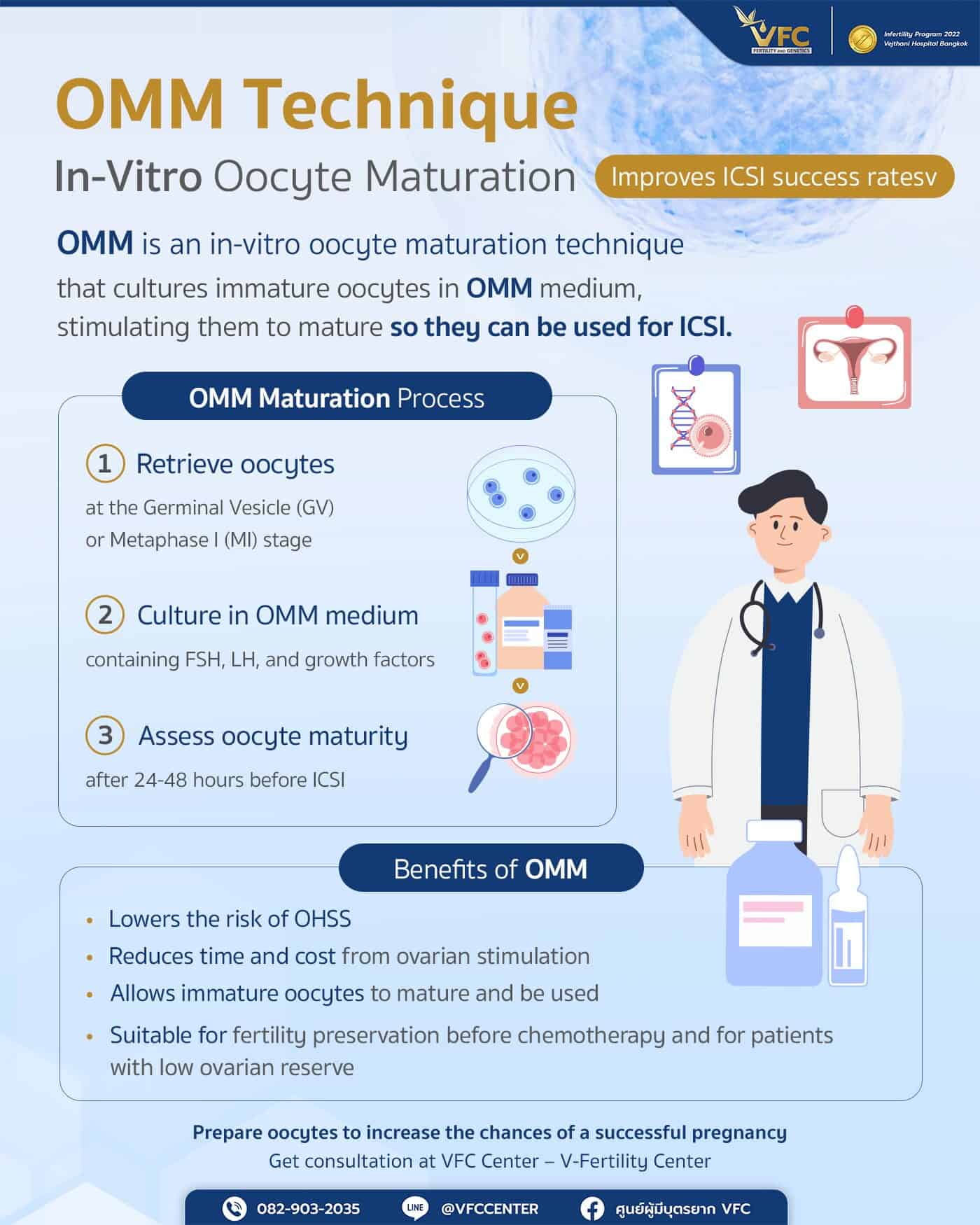
OMM Technique: In-Vitro Oocyte Maturation to Enhance Success and Readiness for ICSI
In IVF and ICSI treatment, the primary goal is to obtain mature oocytes at the Metaphase II (MII) stage. However, on the day of oocyte retrieval, not all oocytes mature simultaneously. Immature oocytes, often part of an immature oocyte condition, may be collected alongside mature ones ; traditionally, these were discarded.
The OMM technique, also known as Rescue In-Vitro Maturation (Rescue-IVM), offers a breakthrough by allowing these immature oocytes to continue developing outside the body under controlled laboratory conditions. This approach recovers their potential, enabling fertilization and embryo development.
Steps of the OMM Technique
- Careful retrieval of all oocytes across the Metaphase II (MII) , Germinal Vesicle (GV), and Metaphase I (MI) stages, followed by detailed laboratory evaluation and comprehensive quality assessment of each oocyte.
- Culturing immature oocytes in OMM medium, enriched with essential nutrients, hormones, and growth factors, mimics the natural ovarian environment. This stimulates the oocytes to develop synchronously in both the nucleus and cytoplasm, ensuring they reach full maturity and are ready for the ICSI process.
- Monitoring oocyte maturation over 24-48 hours by specialized embryologists
- The mature oocytes are then fertilized via ICSI to create embryos, which are subsequently transferred back into the uterus (Embryo Transfer).
Advantages of the OMM Technique
- Reduced risk of OHSS due to minimal or no ovarian stimulation
- Lower ovarian stimulation costs and fewer clinic visits, minimizing physical discomfort
- Enables the use of oocytes that would otherwise be discarded
- Suitable for oncology patients requiring urgent fertility preservation without hormonal stimulation
Who Can Benefit from the OMM Technique?
- Patients with PCOS who have multiple small follicles and a high OHSS risk
- Individuals with previous IVF cycles showing poor oocyte maturation
- Patients with unsynchronized follicle growth
- Patients with high ovarian reserve but poor response to stimulation
- Poor-prognosis patients seeking to maximize every available oocyte
Struggling with immature oocytes and unsuccessful IVF? Get expert consultation at VFC Center
Assessing Embryo Quality with Chromosomal Testing
After successful fertilization via ICSI, evaluating embryo quality with chromosomal testing is a crucial next step. Modern genetic screening techniques help identify embryos with normal chromosomal structures, ensuring the highest potential for a healthy pregnancy.
Available testing methods include:
- PGT-A (SNP-Based)
- PGT-A (CNV-Based)
- PGT-M
These tests facilitate the selection of embryos with the most complete genetic structures, leading to optimal pregnancy outcomes, as follows:
- Improve implantation rates
- Reduce the risk of miscarriage
- Lower the likelihood of genetic disorders such as Down syndrome, hemophilia, and thalassemia
- Enable more effective treatment planning for future IVF cycles
The OMM technique offers an alternative for managing immature oocytes or cases with poor ovarian response. By supporting the oocytes’ development toward maturity, this process provides an opportunity for fertilization and subsequent implantation, potentially enhancing the overall ICSI process.
Plan your infertility treatment from day one at VFC Center (V Fertility Center). Our fertility specialists provide personalized care across every stage—from oocyte retrieval and laboratory maturation to chromosomal testing—at a trusted IVF Clinic in Bangkok, helping you achieve a smoother and more confident pregnancy journey.
Contact or Book a Consultation:
VFC Center – V-Fertility Center
Hotline: 082-903-2035
LINE Official: @vfccenter
Frequently Asked Questions (FAQs)
Can the OMM technique truly reduce OHSS risk?
Yes. OMM minimizes or eliminates the need for high-dose stimulation, significantly reducing OHSS risk.
Does OMM help reduce IVF and ICSI treatment costs?
It can lower costs by reducing medication use and allowing previously unusable oocytes to be fertilized.
Are there side effects from the OMM technique?
Side effects are minimal due to limited hormonal exposure.
How is immature oocyte condition diagnosed?
It is identified through fertility evaluation and laboratory assessment of oocyte quality, guided by reproductive medicine specialists.

The team of specialists in obstetrics and gynecology and reproductive medicine
No Comments
Sorry, the comment form is closed at this time.