



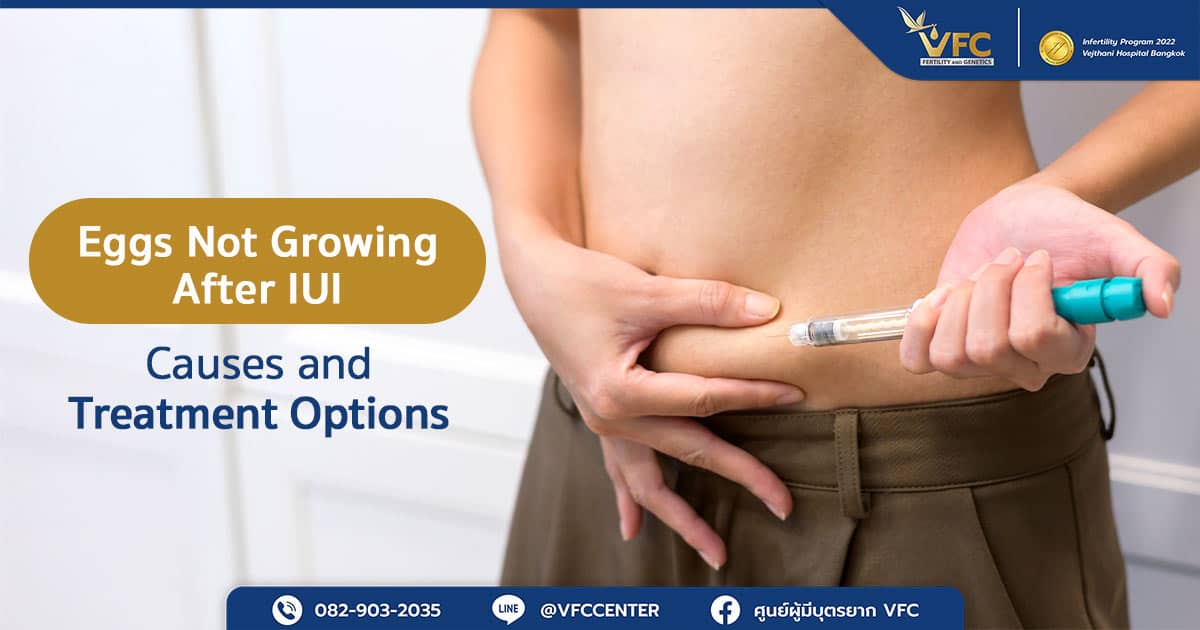
IUI (intrauterine insemination) is often the first-line fertility treatment chosen by many couples. However, treatment can be disrupted when a poor response to ovarian stimulation occurs or when eggs not growing after IUI fail to meet the expected targets. This article explores the underlying causes in depth and presents effective next-step solutions to help increase the chances of a successful pregnancy.
What Is IUI, and Why Is “Eggs Not Growing” a Major Obstacle?
IUI (Intrauterine Insemination) is a fertility treatment in which carefully prepared sperm is directly injected into the uterus during ovulation. This shortens the distance sperm must travel and increases the likelihood of fertilization. IUI is commonly used in couples with uncomplicated infertility, such as unexplained infertility or mild sperm abnormalities.
The Importance of Achieving Fully Mature Eggs Before Insemination
The core goal of IUI is to increase both the number and quality of eggs released in each treatment cycle. Typically, physicians prescribe ovulation-stimulation medications to achieve 1–2 fully mature follicles measuring approximately 18–24 millimeters before administering the ovulation trigger.
When eggs do not grow after IUI, or when follicles develop but fail to meet the required criteria, the following problems may occur:
- No viable target for fertilization: If follicles are too small or not fully mature, the chances of egg release and successful fertilization are significantly reduced.
- Wasted treatment cycle: Inseminating sperm without a high-quality, mature egg often results in an unsuccessful cycle.
If you have undergone IUI and experienced poor egg growth, consult a fertility specialist to reassess your pregnancy plan at VFC Center.
Poor egg growth after IUI? Consult VFC Center
A Closer Look at the 3 Main Causes of Poor Response to Ovulation Stimulation
When ovulation-stimulation medications fail to produce the expected response, it often signals underlying physiological challenges. The most common causes are usually related to reduced ovarian reserve or a treatment plan that is not well matched to the individual. These key factors can be explained as follows:
Age-Related Decline in Ovarian Reserve
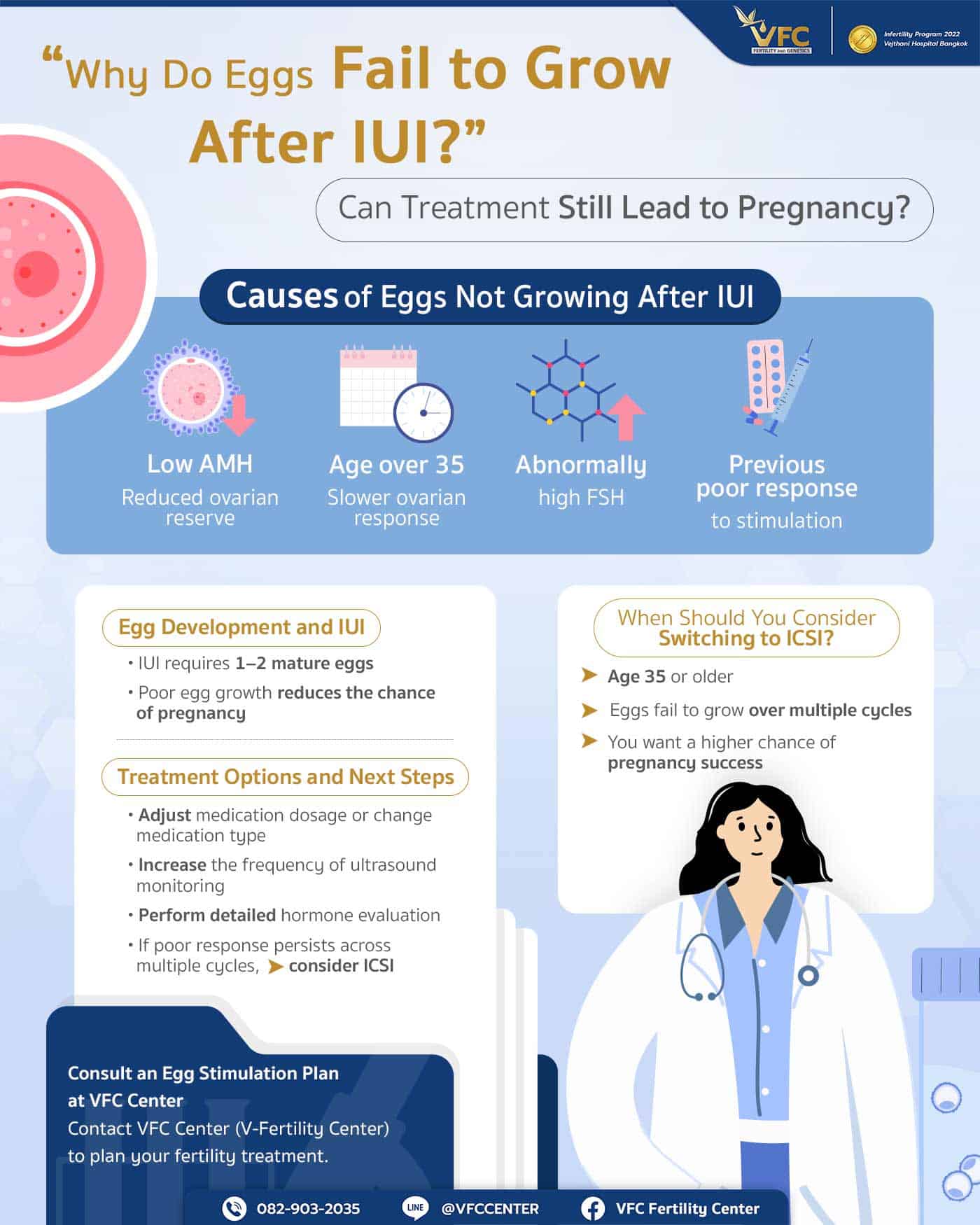
Ovarian response to stimulation medication is directly related to a woman’s ovarian reserve, which reflects both the quantity and quality of remaining eggs and naturally declines with age. This response is primarily influenced by two key hormones:
- AMH (Anti-Müllerian Hormone): The most important marker of ovarian reserve. Low AMH levels indicate a reduced number of remaining eggs, resulting in fewer follicles available to respond to ovulation-stimulation medication.
- FSH (Follicle-Stimulating Hormone): Elevated FSH levels on day 3 of the menstrual cycle indicate that the body is exerting greater effort to stimulate declining ovarian function. When these hormone levels fall outside the optimal range, they are a major reason why ovarian stimulation medications fail to produce an adequate response.
Poor Ovarian Response: POR
Poor Ovarian Response (POR) refers to a condition in which the ovaries respond inadequately to ovulation-stimulation medication, even when appropriate doses are used. Some patients may require higher-than-standard doses or a change in medication type to achieve better results. POR is more commonly seen in individuals with low AMH levels, advanced reproductive age, or a history of poor response in previous stimulation cycles.
Inappropriate Initial Stimulation Protocol Selection
Choosing an unsuitable stimulation protocol from the outset can limit the effectiveness of ovulation-induction medications. This is because stimulation protocols for IUI differ significantly from those used in ICSI, as outlined below:
- Limited stimulation goals in IUI: IUI protocols aim to produce only 1–2 mature follicles to reduce the risk of multiple pregnancy. However, in patients with poor ovarian response or low ovarian reserve, this mild approach may be insufficient to promote adequate follicular growth.
As a result, inaccurate assessment of ovarian responsiveness may lead to under-stimulation and suboptimal treatment planning, causing eggs to fail to grow or remain immature after IUI.
When IUI Is Unsuccessful, Which Treatment Should You Choose Next?
When eggs are not growing after IUI, the next step in treatment should focus on a more personalized approach. This may involve optimizing ovarian stimulation or transitioning to advanced assisted reproductive technologies to achieve the primary goal of therapy, a successful and healthy pregnancy. Currently, there are two main options to consider:
Poor egg growth after IUI? Consult VFC Center

Option 1: Adjusting the Ovulation-Stimulation Protocol (Refined IUI Protocol)
If a fertility specialist determines that pregnancy through IUI is still possible, the treatment plan may be carefully refined with the following adjustments:
- Increasing medication dosage or using gonadotropin injections: These injectable medications are more potent than oral agents commonly used in standard IUI protocols, allowing for more effective ovarian stimulation.
- Closer ultrasound monitoring: Frequent ultrasound assessments enable real-time tracking of follicular growth and timely dose adjustments if poor response is detected early.
Option 2: Transitioning to ICSI for More Predictable Outcomes
ICSI (Intracytoplasmic Sperm Injection) is an advanced IVF technique in which a single sperm is directly injected into the egg. It is often the most recommended option when ovarian response to stimulation is poor during IUI or when eggs are not consistently growing after IUI, for the following reasons:
- Maximum control over ovarian stimulation: ICSI protocols use higher and more intensive stimulation regimens, allowing retrieval of multiple eggs per cycle and increasing the chances of obtaining high-quality embryos.
- Improved fertilization efficiency: ICSI enables direct fertilization without relying on the sperm’s ability to penetrate the egg on its own, making it particularly effective in cases where sperm penetration is challenging.
Eggs Not Growing After IUI Is Not the End, Start a New Path with VFC Center
If you have experienced unsuccessful IUI due to eggs not growing or a poor response to ovulation-stimulation medication, schedule a consultation with a reproductive medicine specialist at VFC Center (V-Fertility Center).
Our team provides comprehensive care at every stage, from accurate diagnosis and personalized adjustment of stimulation medication to tailored treatment planning and guidance on the most appropriate next steps to help improve your chances of achieving a successful pregnancy.
For patients seeking ICSI or IUI treatment in Bangkok, VFC Center offers personalized, evidence-based fertility care designed around your unique reproductive needs.
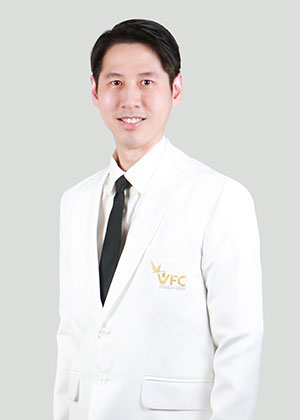
Article by Dr. Worawat Siripoon
For inquiries or to book a consultation:
VFC Center – V-Fertility Center
Hotline: 082-903-2035
LINE Official: @vfccenter
Frequently Asked Questions (FAQs)
Q: If eggs do not grow, can I continue with IUI?
A: IUI may continue only if ovarian response is expected to improve with protocol adjustments, such as higher doses or injectable gonadotropins. If eggs still fail to grow, ICSI is usually recommended due to higher success rates.
Q: How can I tell if I have Poor Ovarian Response (POR)?
A: Common signs include low AMH, high FSH, age over 35, or producing fewer follicles than expected despite standard stimulation doses. Diagnosis is based on hormone test results and prior stimulation response.
Q: If eggs do not grow after IUI, should I move directly to ICSI?
A: Doctors often recommend ICSI when eggs fail to respond over multiple cycles or when risk factors such as very low AMH, age over 35, or a history of POR are present, as ICSI offers stronger stimulation and higher pregnancy success rates.
OBSTETRICS AND GYNAECOLOGY-REPRODUCTIVE MEDICINE
No Comments
Sorry, the comment form is closed at this time.