





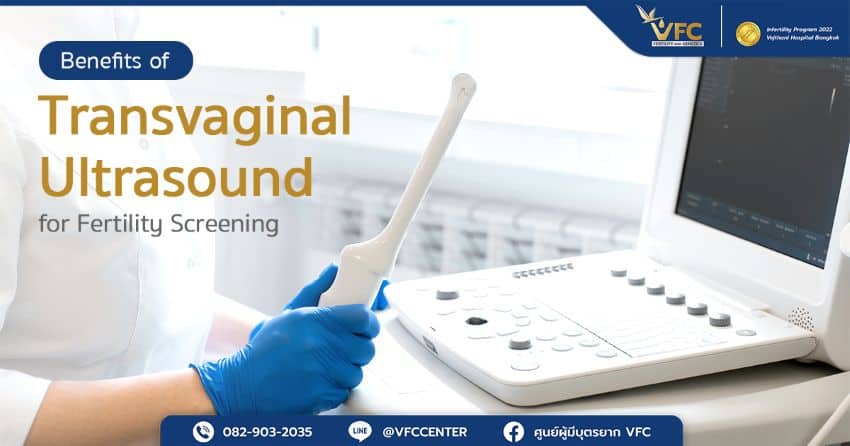
A transvaginal ultrasound is a key part of female fertility screening. It’s a safe, non-invasive scan that helps fertility doctors assess reproductive health in more detail than an abdominal ultrasound. This procedure provides accurate imaging of the uterus, ovaries, and follicles, helping guide diagnosis and timing for fertility treatments like IUI, IVF, or egg retrieval. V Fertility Clinic in Bangkok includes this scan in its comprehensive screening packages. This article explains what a transvaginal ultrasound is, its benefits, how it’s performed, and why it’s one of the standard scans conducted for patients at our leading fertility clinic in Bangkok, V Fertility Center.
What Is a Transvaginal Ultrasound?
A transvaginal ultrasound is a type of pelvic ultrasound designed specifically to evaluate a woman’s reproductive organs, including the uterus, ovaries, fallopian tubes, and endometrial lining. It differs from an abdominal ultrasound, which scans through the skin of your abdomen. A transvaginal ultrasound uses a slim probe that’s gently inserted into the vaginal canal. This approach provides closer, clearer images of reproductive structures and is significantly more precise for early-stage fertility assessment.
The procedure is quick, typically lasting about 5-10 minutes. It’s safe, non-invasive, and doesn’t involve radiation or anesthesia. Most women describe it as mildly uncomfortable at most, with no recovery time needed. This type of ultrasound is standard for anyone undergoing fertility testing or treatment, from initial screenings to IVF cycle monitoring.
Why Is It Important for Fertility Screening?
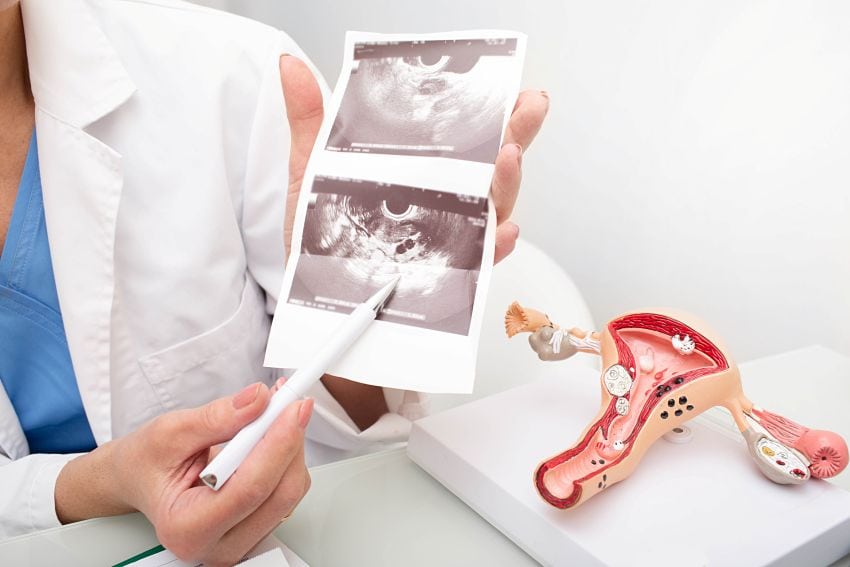
Transvaginal ultrasounds provide important insights into a woman’s reproductive anatomy and health. This test allows fertility specialists to evaluate:
- Uterine size and shape: Helps identify congenital abnormalities or growths, like fibroids and polyps, that may affect implantation.
- Ovarian health: Allows detailed imaging of ovarian size, shape, and presence of cysts or signs of conditions like PCOS.
- Antral follicle count: AFC is a key part of assessing ovarian reserve. The number of visible follicles helps predict egg supply and guides treatment strategies.
- Endometrial lining: Measures the thickness and pattern of the uterine lining, which is critical for embryo implantation.
- Follicular monitoring: Tracks follicle growth to determine the best timing for ovulation, insemination, or egg retrieval.
- Detection of abnormalities: Identifies potential issues such as ovarian cysts, endometriosis, or hydrosalpinx (fluid-filled fallopian tubes) that could interfere with conception.
When combined with fertility hormones such as AMH (Anti-Müllerian Hormone), FSH (Follicle-Stimulating Hormone), LH (Luteinizing Hormone), and Estradiol, ultrasound results paint a full picture of reproductive health. This is especially useful for individuals considering IVF, IUI, or egg freezing.
When Is a Transvaginal Ultrasound Done?
For initial fertility testing, a transvaginal ultrasound is typically scheduled between Days 2 and 5 of the menstrual cycle. This timing provides the most accurate read of baseline ovarian activity and follicle count. In fertility treatment, ultrasounds may be repeated at different phases of the cycle:
- Pre-ovulation: To monitor follicle size
- Mid-cycle: To confirm ovulation
- Luteal phase: To evaluate endometrial changes
- During IVF: To guide medication adjustments, trigger timing, and egg retrieval
This is what happens during the procedure:
- The patient lies comfortably while a thin, lubricated probe is inserted into the vaginal canal
- Real-time images are transmitted to a monitor, where the specialist can examine the uterus and ovaries in detail
Benefits of a Transvaginal Ultrasound in Fertility Testing
For individuals with irregular cycles, previous miscarriages, or unexplained infertility, a transvaginal ultrasound provides essential clarity. This test provides a range of benefits that make it essential in diagnostics and treatment planning:
- Safe and fast: No radiation, no incision, and no downtime
- Real-time monitoring: Allows doctors to monitor the exact day of ovulation or track follicle growth
- Detailed insight into ovarian reserve: Combined with AMH and FSH levels, antral follicle count helps assess remaining egg supply
- Precision timing: Improves success rates for IUI, IVF, and embryo transfers by guiding ideal scheduling.
- Early detection of issues: Many women are unaware they have fibroids, cysts, or endometriosis until the scan identifies them.
- Hormonal condition evaluation: Helps in assessing conditions like polycystic ovary syndrome (PCOS) or other disruptions in fertility hormones.
Why Choose V Fertility Clinic in Bangkok?
Backed by over 15 years of experience, V Fertility Clinic is one of Thailand’s most trusted centers for reproductive medicine. We offer integrated fertility screening packages, which include transvaginal ultrasound, fertility hormone panels, and expert consultation. Our specialists are experts in reproductive endocrinology and obstetrics and gynecology.
Patients receive professional high-quality care in a modern, comfortable, and fully equipped medical environment. We provide support for local and international patients, with bilingual staff and concierge services to ensure a smooth experience from start to finish.
V Fertility Clinic is committed to delivering accurate diagnoses and helping couples make informed decisions. Schedule a specialist consultation and screening appointment at V Fertility Center.
Frequently Asked Questions (FAQs)
What is a transvaginal ultrasound, and how does it work?
A: A transvaginal ultrasound is a pelvic imaging scan where a slim probe is gently inserted into the vaginal canal to capture real-time images of reproductive organs like the uterus and ovaries. It provides clearer, more precise views than a standard abdominal scan.
Why is a transvaginal ultrasound important for fertility testing?
A: This scan helps identify conditions like fibroids, cysts, or irregular follicles, assesses ovarian reserve, and monitors ovulation. It’s essential for tailoring fertility treatments such as IUI, IVF, or egg freezing to each individual’s reproductive health.
When should I schedule my transvaginal ultrasound for fertility screening?
A: It’s best done between Day 2–5 of the menstrual cycle for baseline evaluation. For IVF or ovulation monitoring, additional scans may be done throughout the cycle to track follicle growth and endometrial changes.
Does a transvaginal ultrasound hurt or require downtime?
A: Most patients find it mildly uncomfortable but not painful. It’s a quick, 5–10 minute procedure with no anesthesia or recovery time needed. You can return to normal activities immediately.
Why choose V Fertility Clinic in Bangkok for fertility ultrasound and testing?
A: V Fertility Clinic offers expert-led care, advanced imaging tools, and a full fertility screening package that includes ultrasound and hormone testing. With 15+ years of experience and bilingual support, it’s a top fertility clinic in Bangkok trusted by local and international patients.
References:
-
- Transvaginal Ultrasound Scan. Retrieved on 31 October 2025 from https://www.guysandstthomas.nhs.uk/health-information/transvaginal-ultrasound-scan
- Transvaginal Ultrasound. Retrieved on 31 October 2025 from https://my.clevelandclinic.org/health/diagnostics/4993-transvaginal-ultrasound

The team of specialists in obstetrics and gynecology and reproductive medicine
No Comments
Sorry, the comment form is closed at this time.